For centuries, alchemy was the “moonshot” of the Middle Ages. Figures like Isaac Newton spent countless hours in smoky labs searching for the Philosopher’s Stone – a legendary substance that could transmute base metals like lead into gleaming gold.
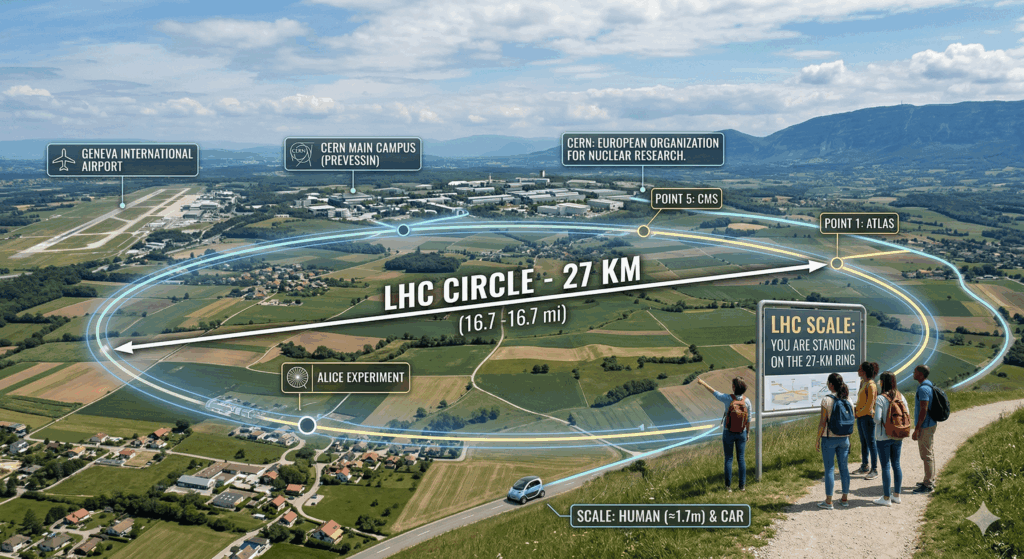
Chemically, they were chasing a ghost. But inside the 27-kilometer ring of the Large Hadron Collider (LHC) near Geneva, modern physicists have finally made the dream a reality.
Why Lead and Gold?
To an alchemist, lead and gold felt like cousins because they were both incredibly heavy. Today, we know that “heaviness” comes from the density of the atomic nucleus.
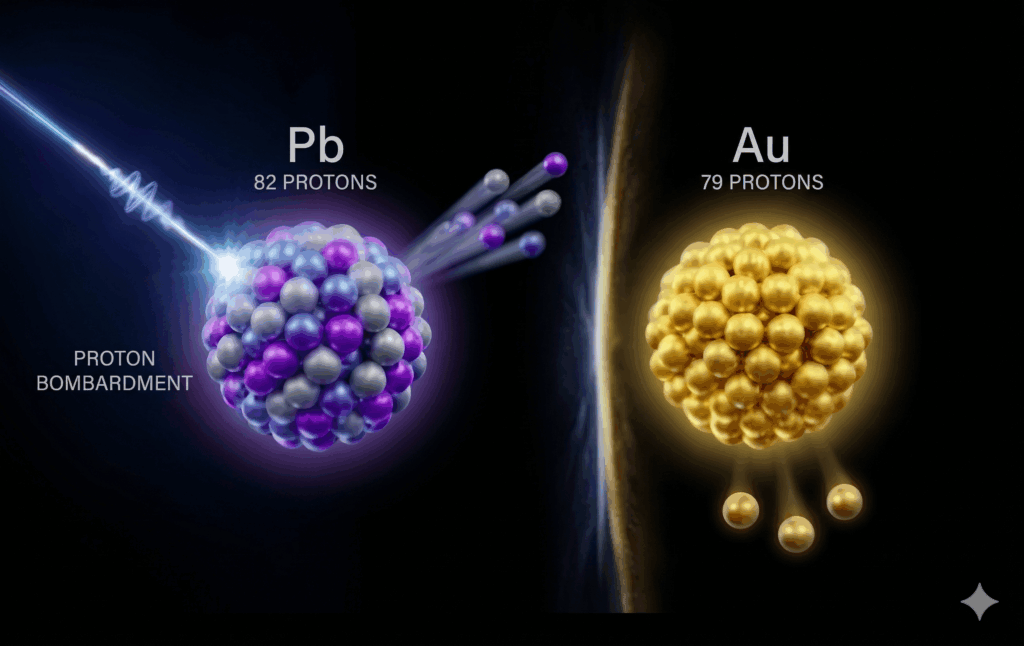
- Lead (Pb): 82 protons
- Gold (Au): 79 protons
To turn lead into gold, you don’t need a magic potion; you just need to “steal” exactly three protons from a lead nucleus. The problem? The nuclear force holding those protons together is one of the strongest forces in the universe.
The ALICE Experiment: A Cosmic Time Machine
At CERN, an experiment called ALICE (A Large Ion Collider Experiment) focuses on recreating the conditions of the universe as they were just 10 microseconds after the Big Bang.
To do this, they accelerate lead nuclei to 99.999993% of the speed of light.
The “Ultra-Peripheral” Trick
Usually, physicists want the nuclei to smash into each other head-on to create a “primordial soup” called Quark-Gluon Plasma. However, gold is created when the nuclei actually miss each other.
When two lead nuclei fly past one another at near-light speed, their electromagnetic fields become incredibly compressed into “pancakes”. This creates a high-intensity pulse of photons (light particles).
- A photon hits a lead nucleus.
- The nucleus begins to vibrate (oscillate).
- The energy is so high that the nucleus “spits out” a few neutrons and—crucially—three protons.
Can We Start Mining the LHC?
Before you trade in your stocks for “CERN-Gold,” there are two major catches:
- It disappears: The gold produced is unstable. It exists for only a fraction of a second before hitting the equipment and fragmenting into smaller particles.
- It’s microscopic: Between 2015 and 2018, the LHC produced about 86 billion gold nuclei. That sounds like a lot, but it adds up to only 29 pikograms.Fun Fact: A pikogram is one-trillionth of a gram. You would need to run the LHC for 100 billion years to produce just one single gram of gold!
Why do we do it?
We aren’t doing this to get rich. We are doing it to understand the fundamental laws of nature, like Quantum Electrodynamics. By observing how lead sheds protons to become gold, scientists can measure the strength of electromagnetic fields at the subatomic level and learn how matter formed in the first moments of our universe.
The alchemists wanted wealth; modern physicists want the “source code” of reality. It turns out the latter is much more valuable.
Bigenetic miracle
If you are fond of science as I am, you might enjoy my book, Biogenetic Miracle!
Thank you for your attention, Lumin Hopper