If you were to look inside the most advanced robots of today, you’d see a familiar sight: copper wires, rigid steel joints, and heavy electromagnetic motors. It’s the same “rigid paradigm” we’ve used since the 20th century. But nature doesn’t use gears and bolts. Your own muscles are soft, efficient, and capable of delicate feats that would crush a standard robot.
We are now entering a “transformative era” where robotics is becoming a discipline of “living” engineering. The secret to this shift? Bubbles.
The Acoustic Frontier: Tiny Engines of Sound
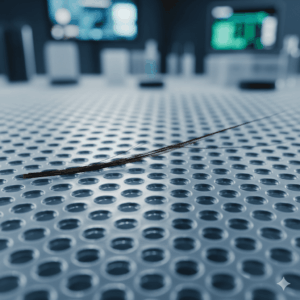
Imagine a robotic “muscle” thinner than a credit card, weighing just 0.047 mg/mm². It has no battery and no wires. Instead, it is powered by sound.
Researchers at ETH Zurich have developed acoustic artificial muscles that use thousands of microbubbles trapped inside a silicone membrane. When hit with specific ultrasound frequencies, these bubbles oscillate—vibrating so rapidly they create “microstreaming jets” that push the robot forward.
Why this matters for medicine:
- No Interference: These robots work at frequencies (1-100 kHz) that don’t interfere with clinical ultrasound (1-20 MHz), meaning a doctor can steer a robot and see it on a monitor at the same time.
- Safe for Life: In tests, these “bubble muscles” were used to create a gripper soft enough to hold a living zebrafish larva without hurting it.
- Internal Navigators: One day soon, you might swallow a pill containing a tiny, biodegradable “stingray-bot” that swims through your stomach to deliver medicine directly to a tumor.
When You Need Raw Power: Phase-Transition Systems
While acoustic bubbles are great for tiny medical bots, they aren’t strong enough to lift a heavy box. For that, we turn to Phase-Transition Actuators.
These systems use a “working fluid” (usually water) that is rapidly heated until it turns into vapor. This liquid-to-gas expansion creates massive force. New 2025 prototypes from researchers Fonseca and Neto have achieved:
- Blocked Force: Over 50 Newtons (enough to power a walking quadruped robot like “Bixo”).
- Low Voltage: They run on just 24V, making them much safer than older “electrostatic” muscles that required 10,000 volts.
The Hybrid Future: Growing Robots from Cells
The most “sci-fi” advancement isn’t just mimicking biology—it’s using it. MIT engineers are now “stamping” skeletal muscle cells into complex patterns, much like the human iris. By using light pulses (optogenetics), they can make these lab-grown muscles contract and dilate.
To keep these soft tissues from tearing when attached to a robot, they’ve developed hydrogel tendons. These artificial tendons allow a robot to pinch 30 times harder than if the muscle were attached directly to a rigid frame.
The Roadmap Ahead
While we aren’t yet at the point of mass-produced “living” robots, the market is exploding. Valued at $2.11 billion in 2025, the artificial muscle industry is projected to hit $4.36 billion by 2032.
We are moving toward “embodied intelligence”– a world where a robot’s body is so smart and flexible that it doesn’t need a complex computer brain to move gracefully; it just needs the right material and a little bit of sound.
Bigenetic miracle
If sci-fi is your thing, you might enjoy my book, Biogenetic Miracle—it explores the very frontiers we discuss here!
Thank you for your attention, Lumin Hopper