So, we’ve established (look at Why we need hot plasma for fusion reaction?) the “simple” part: to get clean, limitless energy, we just need to recreate the heart of a sun on Earth. Easy, right? Except for the minor detail that our “fuel” is a plasma so scorching it would vaporize any physical container you tried to put it in.
Since we can’t use steel or ceramic, we have to get a bit more… ethereal. We need a wall-less container. We need a Magnetic Bottle.
The Lorentz Force: Nature’s Invisible Tracks
To understand how you “trap” a gas that is millions of degrees hot, you have to look at the unique personality of plasma. Because plasma is made of charged ions and electrons, it is incredibly sensitive to magnetic fields.
Think of a magnetic field line as an invisible railroad track. If a charged particle tries to stay still, nothing happens. If it runs perfectly straight along the track, it feels no resistance. But the moment it tries to move across the field lines, a physics “bouncer” known as the Lorentz force kicks in.
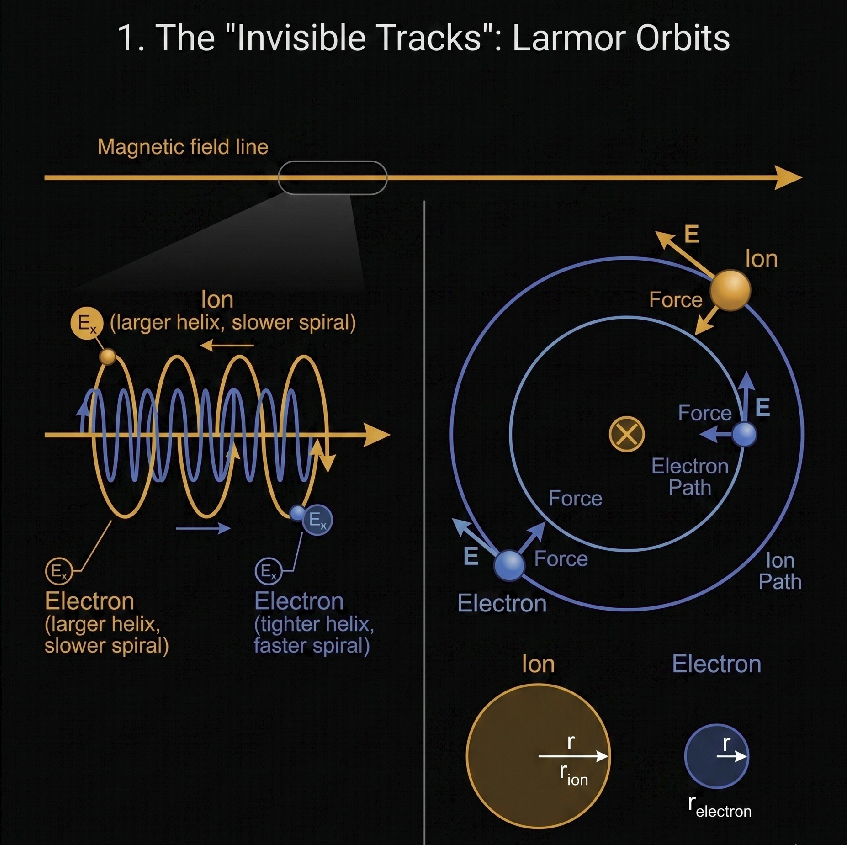
This force pushes the particle perpendicularly, forcing it into a tight, circular orbit around the field line. Scientists call this a Larmor orbit. Because the particles are essentially “glued” to these invisible tracks, they can move freely in one direction but are effectively blocked from moving sideways toward a wall
Why the Earth is an Imperfect Thermos
You might think we could just use a big sphere — like Earth — to hold our plasma. After all, Earth’s magnetic field already traps protons and electrons from the sun (creating the beautiful Aurora Borealis when they leak into the atmosphere).
But “leak” is the keyword there. A sphere is a terrible shape for a fusion reactor because the magnetic field has to come from somewhere and go somewhere. At the north and south poles, the field lines dive straight into the ground. These are “large leaks” where the plasma would simply follow the tracks and slam into the reactor wall.
Entering the Doughnut: The Torus
To make a truly leak-proof bottle, we need a shape where the field lines never end. If we take a cylinder and bend it until the ends touch, we get a torus — or, as I like to call it, the “Fusion Bagel”.
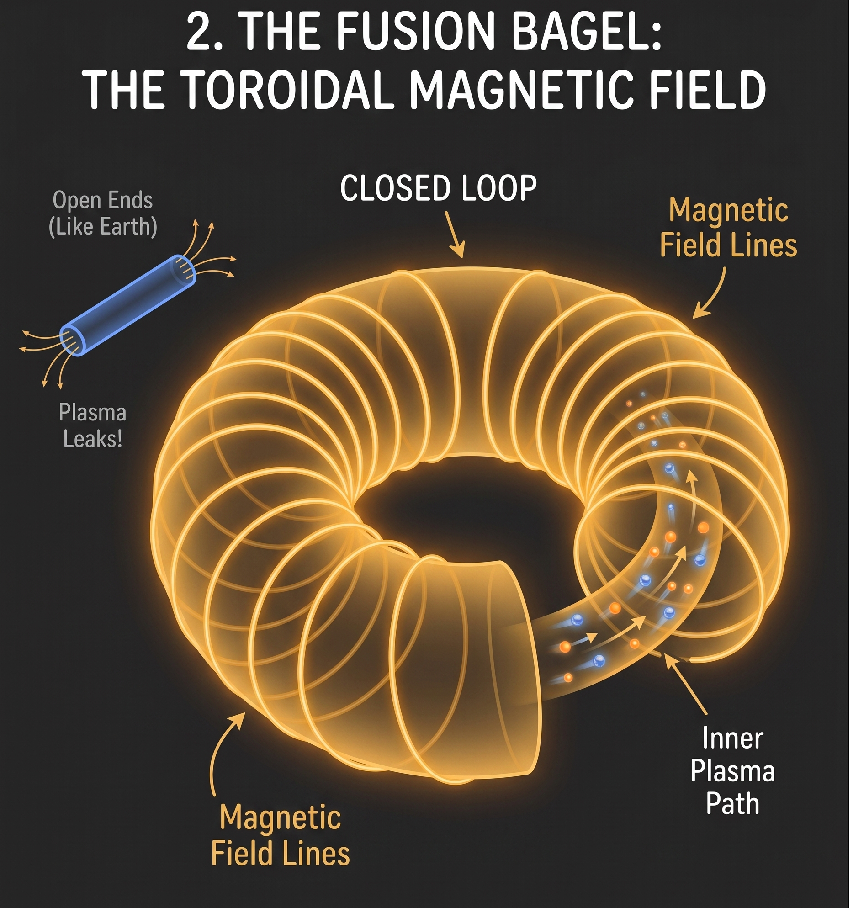
In a torus, the field lines can go around and around in circles (the toroidal direction) or wrap around the short way (the poloidal direction). By combining these, we get helical lines that look like the stripes on a candy cane.
The “Pretzel” Solution and the Great Russian “Black Hunk”
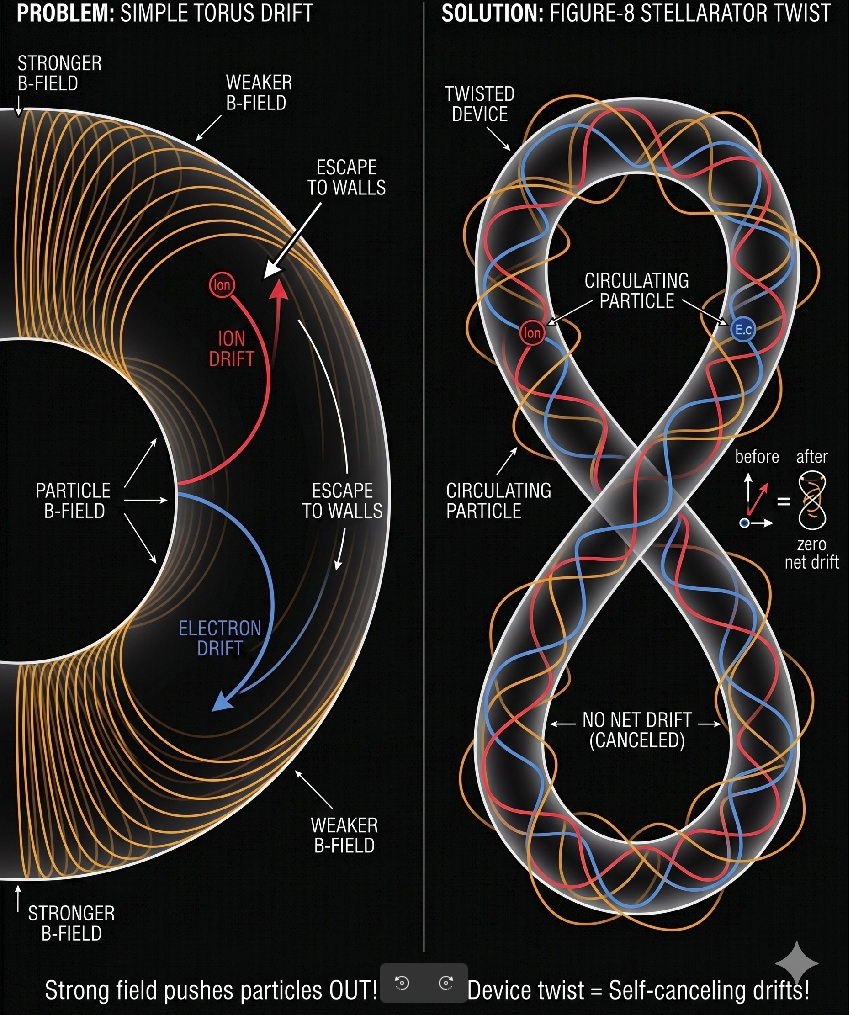
Designing this wasn’t easy. In the 1950s, American physicist Lyman Spitzer realized that a simple torus has a fatal flaw: the magnetic field is stronger on the inside of the “hole” than on the outside. This imbalance causes ions to drift down and electrons to drift up, creating an electric field that blows the whole plasma out of the bottle.
Spitzer’s first fix? Twist the whole machine into a figure-8. He called it a Stellarator, hoping to recreate the conditions of a star. It was a marvel of engineering, but it was incredibly difficult to build with the precision needed to keep the plasma from escaping.
Meanwhile, at a 1958 conference, Russian scientists showed up with a mysterious, unimpressive-looking device called a Tokamak. While Spitzer’s Stellarator used complex external coils to twist the magnetic field, the Tokamak used a clever trick: it ran an electric current through the plasma itself to help create the bottle.
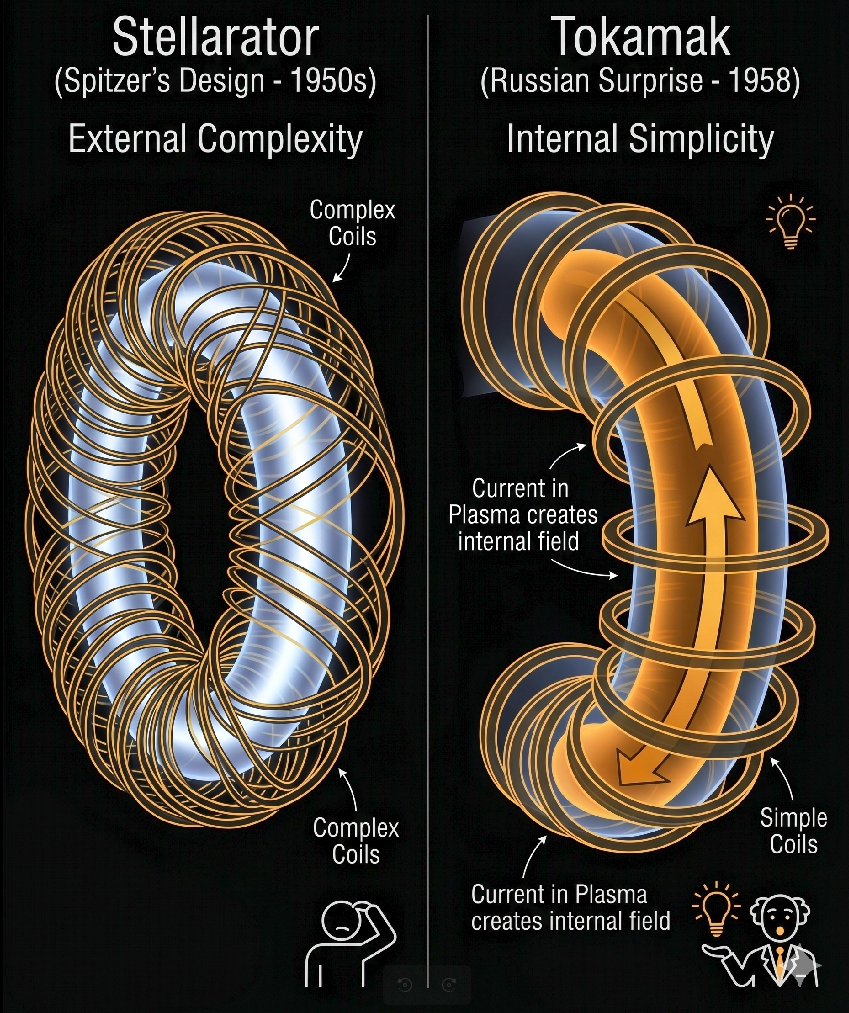
This “self-healing” feature made the Tokamak the early leader in the fusion race. But as we’ll see in the next part, whether it’s a “Pretzel” or a “Bagel,” holding onto a star is a game of chaos, magnets, and extreme patience.
Bigenetic miracle
If sci-fi is your thing, you might enjoy my book, Biogenetic Miracle—it explores the very frontiers we discuss here!
Thank you for your attention, Lumin Hopper